
By Maggie Berry:
Our online lives leave invisible footprints. Every email, photo upload, and streamed episode consumes electricity somewhere in a server farm — electricity often generated by fossil fuels. The good news? You can shrink your digital carbon footprint without giving up technology. By making mindful changes at home and at work, you’ll use devices, data, and energy more efficiently.
Key Ways to Reduce Your Digital Carbon Footprint
Audit your digital habits: track screen time, cloud storage, and idle devices.
Extend device lifespan: repair, upgrade, and reuse before replacing.
Optimize power settings and switch to renewable-powered cloud services.
Digitize documents thoughtfully and manage storage to prevent “data bloat.”
Dispose of e-waste through certified recycling or manufacturer take-back programs.
Digital Weight, Real Impact
Every gigabyte stored in the cloud or streamed across networks requires power. According to the IEA, data centers and transmission networks consume about 1–1.3% of global electricity. The more files, emails, and backups you accumulate, the more energy the system uses to maintain them.
Simple first steps:
Empty trash folders in cloud drives.
Unsubscribe from unnecessary newsletters.
Doing this monthly can reduce data storage energy use by 10–20% for individuals or small teams.
Smarter Devices, Longer Lives
Most of the environmental cost of electronics happens before you ever turn them on — during manufacturing. Extending device life by just one year can cut its lifetime carbon emissions by up to 30%.
Quick checklist for home or office
Keep laptops and phones updated for efficiency and security.
Replace batteries and screens instead of entire devices.
Use energy-saving settings: lower brightness, enable “sleep mode,” and set monitors to power down after five minutes of inactivity.
Buy from companies offering eco-certifications or trade-in programs.
When replacement is unavoidable, consider refurbished equipment. It’s typically 20–40% less carbon-intensive than buying new.
Digital Paper Trails: Why Going Paperless Matters
Switching to digital documentation reduces paper waste, shipping emissions, and office clutter. Scanning receipts, contracts, or records saves physical resources while improving organization. When saving or sharing files, PDFs remain the most universal and energy-efficient format because they compress data efficiently and preserve layout fidelity.
You can convert most file types — Word, Excel, images, and more — into PDF format using free online tools; if you want a reliable, easy option, consider this option. Digitization also makes archival storage greener: a 1 GB PDF library typically consumes 95% less physical and energy footprint than storing equivalent paper documents.
Green Cloud, Greener Code
Even in the cloud, where energy efficiency has improved dramatically, your provider matters. Choose data services that publish renewable-energy commitments or use carbon-neutral data centers (Google Cloud, Microsoft Azure, and Apple iCloud among them).
Before uploading or sharing:
Compress files and images.
Prefer lightweight formats (e.g., .webp over .png).
Limit auto-sync to essential folders.
Use local storage for inactive files rather than always-on cloud connections.
At work, developers can contribute by writing energy-efficient code — avoiding unnecessary background processes and optimizing algorithms to reduce compute time.
How-To Checklist: Greening Your Everyday Tech
Use this short action plan to start right away:
Turn off or unplug idle electronics overnight.
Enable “dark mode” on devices with OLED screens.
Schedule automatic system updates during low-demand hours.
Use a smart power strip to eliminate phantom loads.
Recycle or repurpose obsolete devices responsibly.
Small, consistent actions multiply — especially across teams.
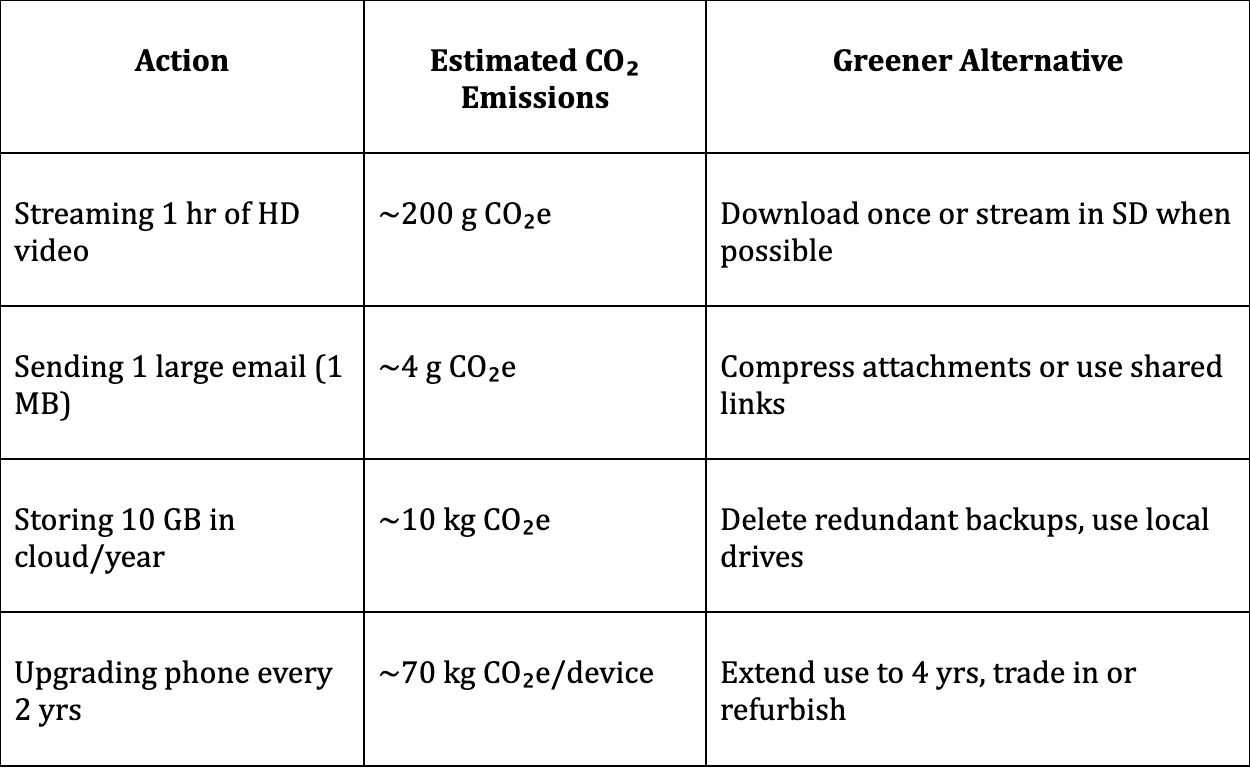
Comparing Common Digital Actions
Frequently Asked Questions
Before you start decluttering your digital life, here’s what people often ask:
1. Does deleting emails really make a difference?
Yes. Each stored email uses a tiny amount of server power; multiplied by billions, it adds up. Deleting old newsletters and spam can lower the load on mail servers and reduce associated emissions. While the effect per person is modest, it’s significant at scale.
2. What about renewable energy at home — will that offset my device use?
Using renewable energy at home directly reduces your carbon footprint. However, the larger impact often comes from extending device lifespans and choosing cloud providers powered by renewables. Combining both approaches yields the best results.
3. Are dark modes and minimalist designs truly greener?
On OLED screens, dark mode saves noticeable power because fewer pixels are lit. Minimalist design in websites or apps also cuts data transfer, reducing network energy consumption.
4. How can a business encourage employees to adopt greener digital habits?
Start by setting clear digital sustainability goals, such as limiting duplicate cloud storage, implementing centralized backups, and offering incentives for refurbished device purchases. Regular audits help maintain progress.
5. What’s the safest way to dispose of e-waste?
Never throw electronics in household trash. Use certified e-waste recyclers or manufacturer take-back programs. They recover valuable metals safely and prevent toxic materials from entering landfills.
6. I work remotely—does that make my footprint worse or better?
Remote work can cut commuting emissions dramatically, but increased data transfers and home energy use can offset some gains. Use efficient video call settings (e.g., 720p instead of 1080p) and unplug devices when not in use to stay net positive.
Conclusion
Greening your digital life isn’t about sacrifice; it’s about awareness. By maintaining your devices, storing smarter, choosing greener providers, and digitizing wisely, you’ll conserve both energy and resources. Start with three commitments today — declutter your cloud, adjust your power settings, and recycle an old gadget — and your everyday actions will help power a cleaner internet for everyone.