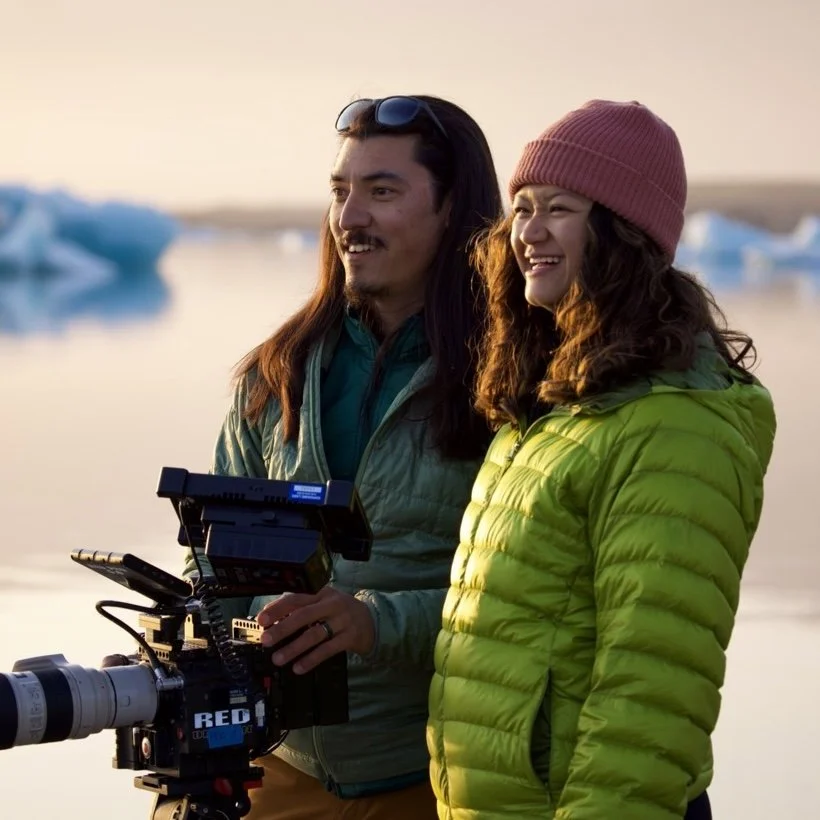
Co-Directors of Chasing Time (pictured above) are Sarah Keo and Jeff Orlowski
Chasing Time captures the urgency behind the science, following communities and experts racing against the clock to protect a livable future.
One Earth (OE): Your film deals with the urgency of the climate crisis. Why is this story particularly important now?
Sarah Keo (SK): When Chasing Ice was first released, James Balog and the Extreme Ice Survey set out to prove that climate change was real through visual evidence of a changing planet. Fifteen years later, we made Chasing Time not to prove that climate change exists, but to confront how urgently we need to act.
As James says at the beginning of the film, climate change is no longer distant or abstract. It’s already shaping people’s lives, decisions, and futures in very real ways.
Chasing Time is less about sounding the alarm and more about asking what we do with the time we still have. It’s about the human side of that equation: how we process urgency, how we show up for one another, and how we move from awareness to meaningful action.
OE: What did you learn about the pace of environmental change while making the film?
SK: The first time we saw the time-lapse sequences come together, we were struck by just how drastic the changes to these landscapes were. Chasing Ice captured three years of photography, while Chasing Time spans over fifteen years. Watching these majestic glaciers—these living, breathing creatures—disappear over that timeframe was deeply unsettling.
We wanted to elevate this unprecedented visual record to help people understand that glacier melt is not only accelerating, but in many cases happening faster than previously predicted.
Although the film focuses on Iceland, what’s happening there is a microcosm of a global system. Our ecosystems are deeply interconnected. Glacial melt contributes to sea-level rise and ocean warming, which intensifies extreme weather events, leading to flooding, drought, and wildfires.
The climate crisis isn’t isolated to one place. It’s already unfolding in all of our backyards. And responding to it will require a level of collective awareness and action that matches that scale.
OE: What gives you hope that humanity can still act in time?
SK: During the making of the film, one of our Executive Producers, Linda Cornfield, shared a piece of advice that stayed with us: “This work isn’t a sprint, nor a marathon. It’s a relay race. We each run our leg and pass the baton.”
That idea became a guiding principle for us. One of the core themes of Chasing Time is mentorship—not only between James and Jeff on screen, but behind the camera as well. That exchange of knowledge and perspective shaped how we think about storytelling and impact change into the world.
We each inherit a body of knowledge, experience, and urgency from those who came before us. We have a responsibility to carry that forward and to invest in the next generation of climate leaders, storytellers, and advocates who will continue this work long after us.
Real change doesn’t happen in isolation. It happens when people share resources, support one another, and bring different perspectives together in pursuit of a common goal. That kind of intergenerational collaboration is what gives me hope—that we’re not starting from scratch, but building on a collective effort that continues to grow and evolve to build toward a better future.
Book your tickets for the April 24th Screening of Chasing Time today!