
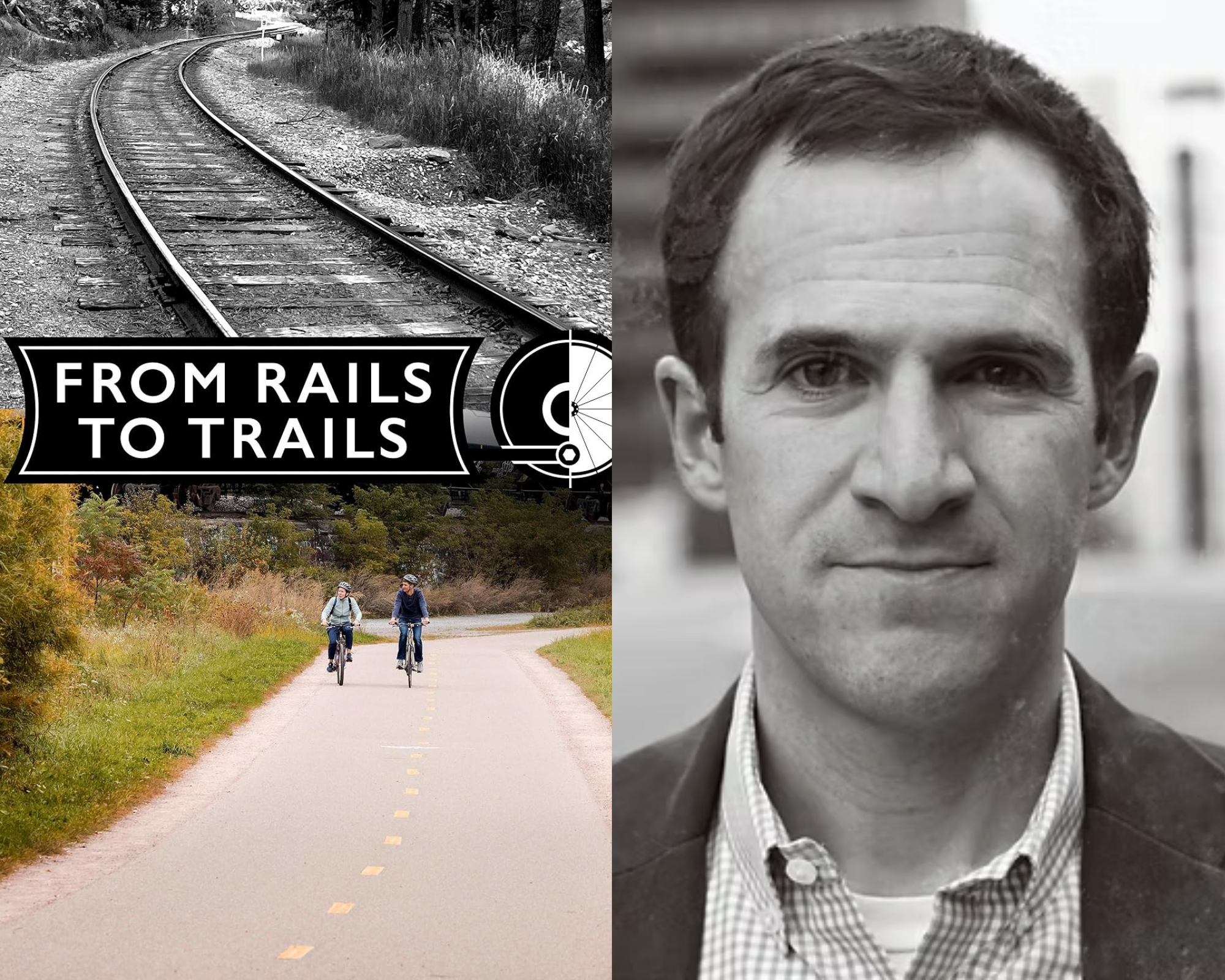
What happens when the tracks that once divided us start bringing us together?
From Rails to Trails explore how everyday spaces can become catalysts for environmental and social change.
One Earth (OE): Rails to Trails shows how old infrastructure can become new community spaces. What drew you to this story?
Dan Protess(DP): I was approached by Peter Harnik a few years ago about the idea of making a documentary—Peter is the co-founder of the Rails to Trails Conservancy and the author of a book about the history of the movement to transform abandoned railroads into trails. What he did not know when he brought the idea to me is that I am a daily rail-trail user. I run every day on the 606, which is near my home, and so I am well aware of what an asset rail-trails can be for our communities. But before committing to the project, I had to sit down with Peter’s book and get a sense of whether there was an engaging story there. I realized that these trails all owe their existence to hard-fought political battles over the past 50 years. And of course, battles and conflicts often make for good stories.
OE: How do trails help reconnect people with nature and each other?
DP: One of my favorite stories in the film is about May Watts, a naturalist from suburban Chicago who sparked the entire movement back in the early 1960s. She had traveled to England and was struck by the ancient footpaths there—the way they were open to everyone, young and old, rich and poor. She came home and saw a long-abandoned rail corridor cutting through the sprawl west of Chicago, and realized that the native prairie plants were actually thriving there, undisturbed. Her insight was simple but radical: you shouldn't have to travel to get to nature—nature could be right outside your door. We illustrated the same idea with a story in Brownsville, Texas, where the community fought against a proposed toll road, and insisted on building a trail there instead. One of the organizers rode her bike along the finished trail and described hearing the birds, seeing the water, watching kids play, and contrasted it with a toll road, where she said, "you'd be driving fast and you'd miss all of that."
OE: What role can green infrastructure play in building healthier communities?
DP: The story that really drove this home for me was Atlanta's Beltline—a 22-mile trail built on an old railroad loop encircling the city. It was the brainchild of a graduate student named Ryan Gravel, who wanted to make Atlantans less dependent on cars. His vision was to connect people to housing, retail, and parks, which they could access on foot, on a bicycle, or on transit. Brownsville is one of the most economically challenged cities in Texas, with diabetes rates among the highest in the country, and building a trail there instead of a toll road was a genuine public health intervention for a community that needed it. Pete Buttigieg, who we interviewed for the film, described the movement as "the beginning of a course correction"—but also noted that there's still a long way to go. That tension is something I find really compelling: 26,000 miles of rail-trails is an extraordinary achievement, and yet it barely scratches the surface of what's possible.
