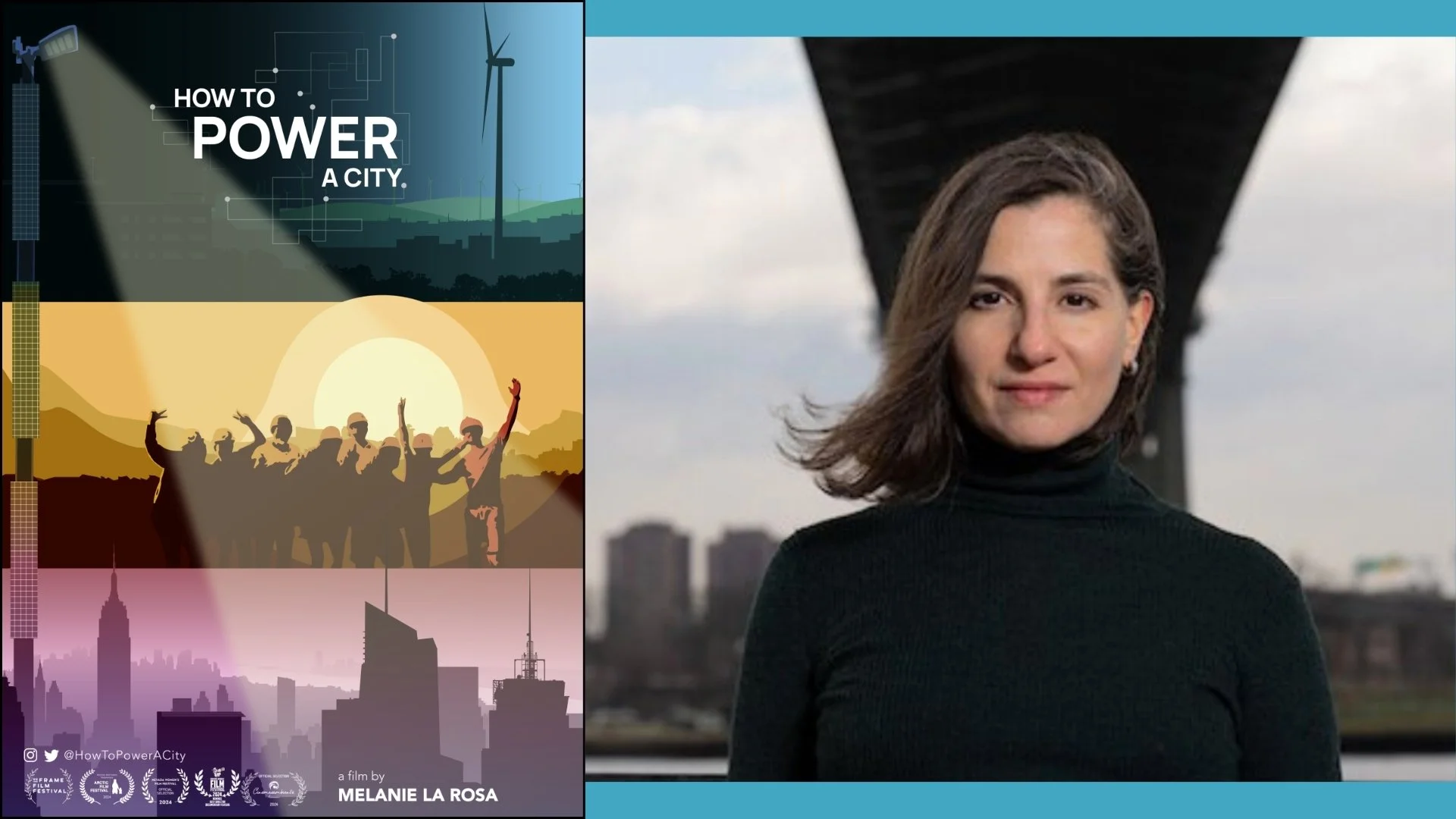
Film Spotlight: Interview with Director of How To Power A City, Melanie La Rosa

Movie Poster for How To Power A City & Melanie La Rosa

One Earth (OE): Cities are at the center of the climate conversation. What inspired the focus on urban energy solutions?

Melanie(M): I learned about solar being introduced to New York City, where I live, and also wind power throughout the state. I grew very curious about how this works. How can one tiny solar system on a high-rise make a difference? How can more infrastructure fit into an already crowded place? How does wind power in a rural area like upstate NY even help New York City? I didn't know, at the time I started the film, how the grid worked and I had a real crash course in engineering and physics, which I loved.

My research was expansive at the beginning and I was also looking at rural areas. But much of the information at that time, for rural places, would be something like an off-grid cabin in the woods. I felt like people understood how that worked but understanding of how this works in cities and congested urban areas was more limited. Plus, it was a different time when I was doing this research (as far back as 2015 although mostly in 2016-17) and cities were making very impressive commitments to renewable energy. So that's what I followed. The story that was emerging was about how cities wanted to do this, and I wanted to see how they would chip away at it.

In the end, I did include rural areas through the Puerto Rico and Vermont stories. I have several takeaways from these differences. There's no one size fits all plan. Places like Las Vegas and New York City have vastly different energy usage than a rural area in Puerto Rico. Also the grid is important for urban areas but in Puerto Rico and Vermont, the solar installations were actually re-designs, to an extent, of the grid. In both of those places there are mountains and the grid extends through these mountains for miles, to reach small, clustered populations. That means miles upon miles of cables through largely unpopulated areas. Both also regularly have extreme weather events that damage the grid, meaning lots of maintenance. In both places people felt like this design of a central grid caused a lot of expense and maintenance, but local microgrids made more sense and were also easier to maintain. 

But that's not really viable in New York City, for example, because of the massive energy use and interconnectness. While there are some microgrids being introduced to cities, the urban solutions have to chip away at a bigger system and add clean infrastructure like Renewable Rikers, which is a piece of a system. But an important piece that replaces the most polluting part of the old system with new, clean technology. This also addresses issues like air pollution and environmental justice in addition to energy production. 

Because each place in the film has such different geography, needs, energy use, and available resources, I'm glad that, in the end, my title of "How To Power A City" extended to include smaller areas and populations as well as large urban areas.

OE: What challenges did you uncover when trying to transition an entire city to renewable energy?

M: In Las Vegas, Mayor Goodman truly led the nation and maybe the world in transitioning the city's energy use to renewables. The challenges there were figuring out how to finance it, although when I interviewed her for the film she really didn't speak about that much, as it was more of an administrative challenge. She said her city council was all very aligned in wanting the renewables.

In New York City, the challenges are enormous. As mentioned above, the design of creating something that will make a difference and also be feasible. Getting that approved by the City Council. Then inevitable backlash and delays in implementation. In the NYC story in the film, Costa Constantinides leads the passage of two key laws: Renewable Rikers, which I focused on, and also a NYC Green New Deal law that limits building emissions. He had to face the challenges of fossil fuel lobbyists who don't want to see these get passed and implemented. He had to build and lead coalitions of supporters for years to get these laws passed. 

This didn't make it into the film because we'd concluded filming before the pandemic, but since you are asking about challenges one big one is that even with great laws like Renewable Rikers getting passed, they are not always implemented right away. Opponents of these laws include building owners who don't want to invest in cleaner heating systems, and are trying to undermine the fines that buildings will pay if they don't comply with the NYC Green New Deal. Renewable Rikers is current law but  it's progress has been very slow, and also our last mayor made it a relatively low priority level. There's a lot of hope that under Mayor Mamdani it will speed up. 

An important overarching challenge is that the public does not understand how energy systems work, even if they are generally in support of renewable energy. That's why events like the One Earth Film Festival are so important to start the conversations that help us learn together. There is an incredible amount of misinformation in the news about renewable energy, and yet we all stand to benefit so much from learning how these work so we can advocate for them in our own communities. It's wonderful to know you are keeping this conversation going.

OE: How can communities and policymakers work together to power cities more sustainably?

M: This is really the core question the film addresses - because each community differs in needs, priorities, budget, and geography, each must determine what works best for them. But there are some throughlines. City council members told me that hearing from community members about wanting solar or wind power is important. Someone has to start a conversation! If a policy maker never hears from local residents  that they'd like to see solar or wind in their community or they'd like a town hall or event, you can understand how other things might take priority. So just engaging at a very basic level is crucial. In my own neighborhood in Queens we have a group that meets regularly to talk about energy innovations in the city, makes phone calls, and engages with state policies. 

Informing yourself about what works locally is also key, and there are groups like Solar United Neighbors that work in dozens of states that can be a great starting point. 

By the way, most policymakers addressing energy policy are at the city or state level, not the federal level. 

I can share a variety of ways I've seen communities work with policy makers: 

In the film, just a few examples are:

- New York City policy makers hold town halls to discuss how solar or wind works in the city.

- New York City policy makers work with local community leaders to address a major concern - air pollution and asthma - by creating a renewable energy project that will also "turn off" an exceptionally polluting part of the existing system, called peaker plants. This was a very long process that required the participation of many community leaders and policy makers.  

- In Puerto Rico, people in small rural towns worked with their local mayors, and many created hurricane-resilient community centers by having donated solar panels and batteries installed on places like cafes and community centers.  

- In Highland Park, Soulardarity works very closely with the City of Highland Park in creating places for the off-grid solar powered streetlights; this involves getting access to the little strip of ground that the streetlight must stand on. This is kind of technical but it is a make-or-break detail that requires policymaker input and decisions. 

- In Highland Park, having a tiny solar off-grid garden shed provided a way for people to see a solar power system up close. It only made enough electricity for the garden tools but it was also easy, inexpensive, and tangible. Sometimes seeing these projects on a small scale allows people to glimpse the larger picture, and they learn a lot from them. Policy makers can work with community gardens, for example, to have small solar panel setups for the garden's use.    

From other places that have screened the film:  

- An Ohio city built low-income housing with solar panels, and held a big public event to educate the people who were going to get these homes about solar. (They screened How To Power A City at the event to help people learn about solar). 

- Another screening in Ohio brought a state representative to speak on a panel afterwards about her efforts to lead solar in Ohio. This was at a science museum and it helped show that solar is possible in the Midwest (because part of the film is in Michigan) and that there are steps to creating these systems, it's not all at once. 
Get a ticket to How To Power A City on 4/24

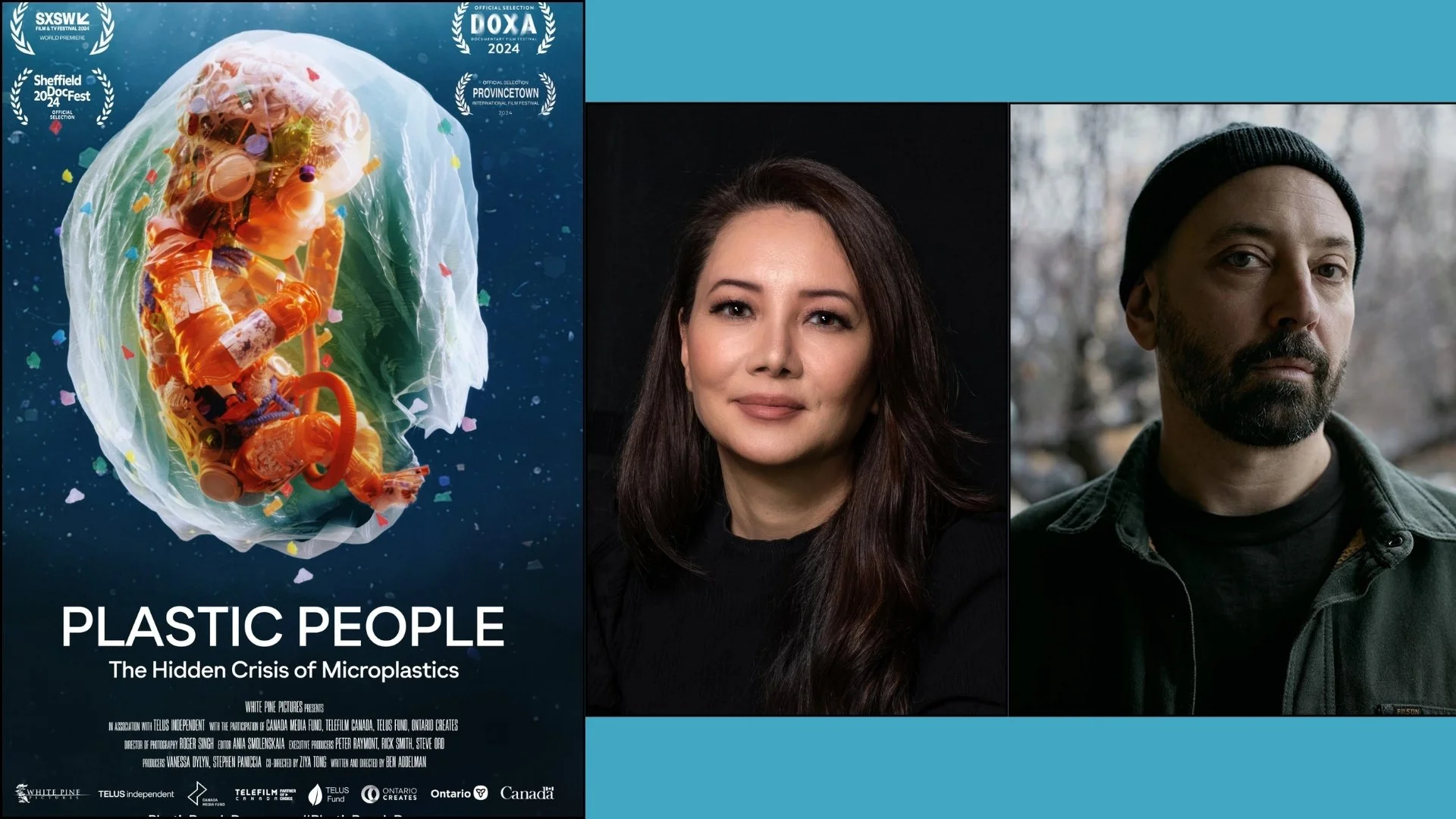
Film Spotlight: Q&A with Directors of Plastic People, Ben Addelman and Ziya Tong

One Earth (OE):Your film exposes the hidden presence of microplastics in our bodies and ecosystems. What surprised you most during the investigation?

Ziya: Seeing the lab results. The really strange thing to stomach in a way is the fact that you've got other people's garbage in your body.  Seeing other people's garbage floating around in your system is really quite shocking.

OE: How does the issue of plastic pollution illustrate why environmental solutions must be collective and systemic, not just individual?

Ben: People were trained to use disposable items, trained to throw out their coffee cups.  They were resistant to it at first.  We can go back to using glass or tin.  It's easier to start with something simple like single-use plastic, but it can make a big impact. 50% of all the plastic ever made has been made in the last 20 years.  By not using single-use plastic, our consumption would be reduced considerably.

OE: What changes,policy, industry, or cultural, do you believe are most urgent right now?

Ben: While we were in the middle of making our film, a very important treaty, a global treaty with all the countries around the world meeting to agree on solutions.  Called the Intergovernmental Negotiating Committee on Plastic Pollution, it was organized by the UN Environmental Program and continues to meet.  Cooperation and policies among all nations would help to address the environmental and health crisis.

Get a ticket to Plastic People on 4/23

Community Spotlight: Interview with Princess Harris, Sustainable Food & Land Use Senior Coordinator, Faith in Place

Visit with Princess Harris of Faith in Place at One Earth's Earth Day Action Fair Sunday, Apr 26.

One Earth (OE): What are the most pressing global challenges you’re currently focused on, and how do they connect to local communities like Chicago?

Princess Harris(PH): The most pressing global challenges I’m focused on are climate change, environmental justice, biodiversity loss, and food insecurity—and all of these are deeply connected to communities right here in Chicago.

Climate change is not just a global issue—it shows up locally through extreme heat, flooding, and shifting seasons along Lake Michigan. Environmental justice is central, because the impacts of pollution and climate stress are not felt equally—many frontline communities in Chicago experience higher exposure to poor air quality, limited green space, and fewer resources to adapt.

At the same time, biodiversity loss affects our local ecosystems, from pollinators like monarch butterflies to native plants that support healthy soil and water systems. And food insecurity continues to impact families across the city, making access to fresh, culturally relevant food a critical need.

What connects all of this is community. In Chicago, we can respond through local action—community gardens, stewardship of natural spaces, education, and partnerships that center the voices and leadership of residents. When we invest in local solutions, we’re not just addressing global challenges—we’re building resilience, equity, and sustainability right where we live.

(OE): How does your organization help Chicago residents engage with global issues like climate change, human rights, and sustainability?

(PH): At Faith in Place, we help residents in Chicago connect global issues like climate change, human rights, and sustainability to their everyday lives through community-based programs, education, and hands-on engagement.

We translate global challenges into local action. Through community gardens and garden classes, we address food insecurity and sustainability by teaching people how to grow their own food, care for the land, and build food sovereignty. Our Migration & Me program connects human migration stories—including the Great Migration—with the migration of species like monarch butterflies, helping participants understand climate change, displacement, and resilience on both a human and ecological level.

We also create opportunities for residents to directly engage with nature through stewardship days, nature outings, and events like Double Dutch Fest—spaces where people can build relationships with the environment while learning how to protect it. This work is grounded in environmental justice, ensuring that communities most impacted by climate and inequity are centered, heard, and equipped with tools to advocate for themselves.

Ultimately, we help people see that global issues are not distant—they are happening right here. And more importantly, we show that everyone has a role to play in creating a healthier, more just, and sustainable future.

(OE): If you could leave Chicago residents with one message this Earth Day, what would it be?

(PH): The care we show to our environment is the care we show to each other.

Here in Chicago, every small action—planting a seed, protecting a tree, showing up for a cleanup, or simply spending time in nature—connects us to something much larger. You don’t have to do everything—but you do have to do something. Care for the land in front of you. Listen to your community. Stay connected to the natural world.

Because when we take care of the Earth, we are also taking care of ourselves, our neighbors, and the generations that will come after us.

Film Spotlight: Interview with Nathan Harvey, Director of Beyond Zero

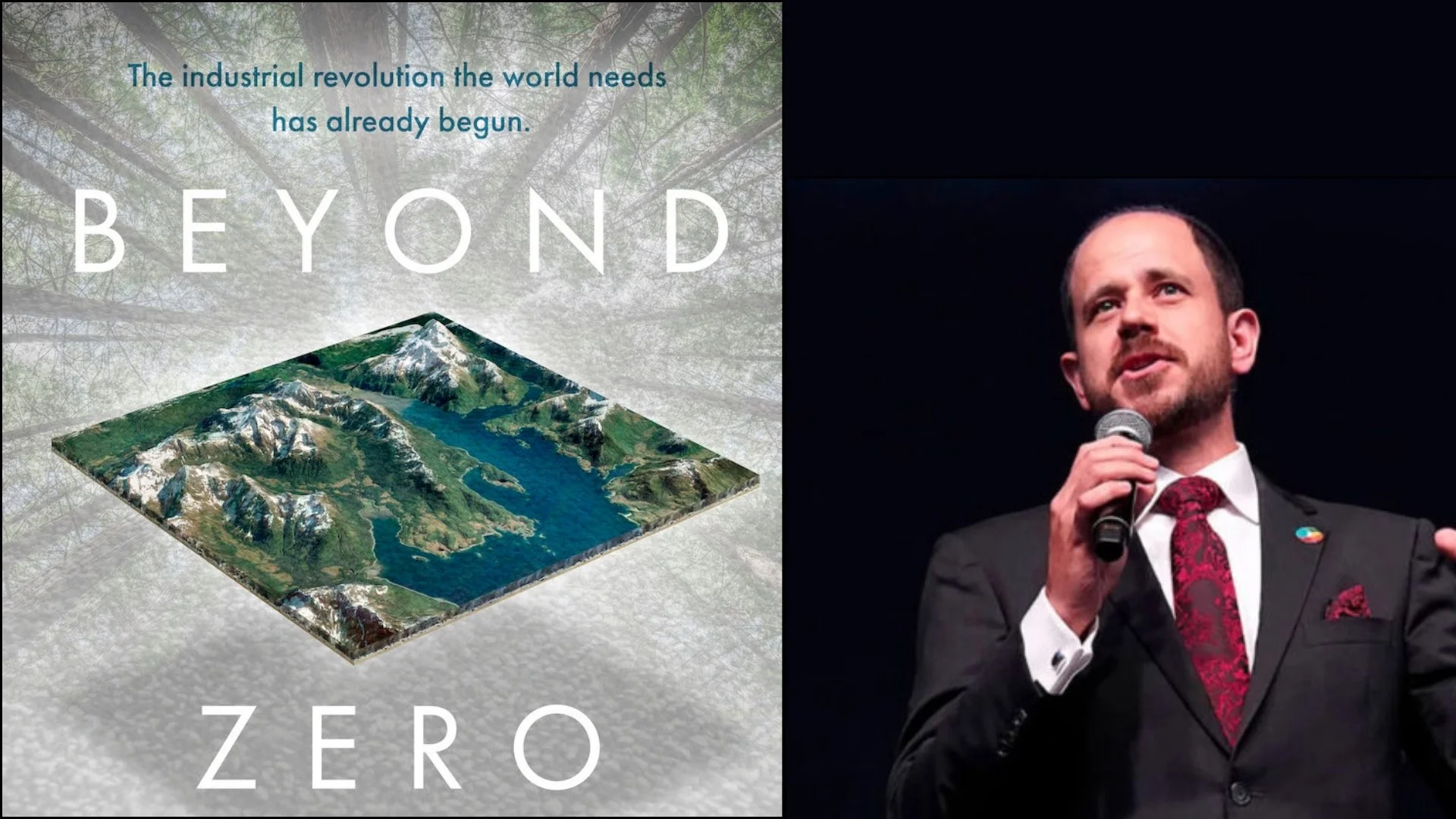
Movie Poster for Beyond Zero & photo of Nathan Harvey

One Earth (OE):Beyond Zero shows how businesses can transform their impact on the planet. What lessons from this story feel most relevant today?

Nathan Harvey (NH): The most important lesson is the ambition that interface had. They began with the question of what their business would be like in a world where industry and ecology were in harmony, and then they started to figure out how to close the gap. Every business can (and must) follow their lead - and if they do, they will realize the same advantages Interface enjoyed, and still enjoys today.

OE:How can companies become part of the GenWe movement(Our theme displaying that people regardless of their age range can work together to help our planet), working alongside communities and activists?

NH: Companies need to start by acknowledging the aspect of business as usual that won't work in a sustainable world. Then they need to figure out which of those aspects they are best positioned to solve. Companies (and we as individuals) are complicit in many systems that need to change, but we can't do it all. So we need to focus on a small number of things we can do, and get them done.

Interface didn't tackle shipping, they didn't tackle the concrete on which their carpet was laid, they didn't tackle deforestation. They tackled what they were best able to tackle, and in doing so, they made available to the world a choice that is consistent with a sustainable future. So that one is solved. Now we all companies need to do the same for the thing that is theirs to do.

OE:What surprised you most about the people who helped drive change inside the company?

NH:They were normal people, just like the people at work in every other company. They weren't environmentalists before. But once the company committed to doing what needed to be done - they became the amazing team that did it.

Get a Ticket to Beyond Zero on 4/23

Film Spotlight: Interview with Colleen Thurston, Director of Drowned Land

Colleen Thurston

One Earth (OE): Your film explores communities impacted by rising water and environmental change. What stories stayed with you the most after filming?

Colleen Thurston(CT): The story that immediately piqued my interest - and horror - in this project was that of Sardis Lake. Sardis is a man-made reservoir built in the late 1970s by damming a tributary of the Kiamichi River and flooding the town of Sardis, Oklahoma in the Choctaw Nation. The entire town was decimated, with the cemetery the only remaining relic. The Army Corps of Engineers opted to raise the cemetery by removing the headstones, piling on several feet of soil, and then replacing the headstones. But as Joe Brown says in Drowned Land, "Some people say they didn't put them back in the right place." The cemetery is now an island in the middle of the lake, only accessible via a narrow land bridge. Locals say there were other cemeteries, mainly of Native residents of the area, which were flooded and now are at the bottom of the lake. As someone who has a family cemetery in rural Choctaw Nation that is nearly 200 years old, the idea of losing our ancestors in this way is absolutely horrific. As I came to find out, this story is not unique to Sardis, but it stays with me as visual symbolism of how far the federal government will go to exploit the land and water. If we don't even value our ancestors, if we don't value our water and land - where do our values sit?

(OE): How do these communities demonstrate the importance of collective resilience in the face of climate challenges?

(CT): The communities profiled in Drowned Land are the face of resilience. Displaced generation after generation due to resource exploitation, they now face not only the continued commodification of their water sources, but also the effects of rising water temperature. Nevertheless, for people who rely on farming, hunting and fishing, adaptation is the name of the game. Rural communities have deep relationships with the land and water, and tracking the changes in weather patterns, water flow, and drought is imperative. Rural communities like those who live in the Kiamichi watershed are the waterkeepers, the land stewards and the ecological knowledge keepers from whom we all can learn more.

(OE): What do you hope audiences understand differently about land, water, and climate after watching the film?

(CT): I hope audiences can understand the importance of having deep relationships with our land and water sources, and are encouraged to learn more about where their drinking water comes from, who the current and ancestral stewards of that water are, and what challenges that water currently faces. We want people to form lasting relationships with their water sources, viewing them as living entities who can share memories and experiences with us.

Film Spotlight: Interview with R.T. Thorne, Director of 40 Acres

R.T. Thorne

One Earth (OE): 40 Acres explores land, legacy, and resilience. What inspired you to document these stories?

R.T. Thorne (RT): Much of the inspiration of the film comes from my personal upbringing. I was born in the outskirts of Calgary, Alberta. My father worked in the produce supply industry, and so at a very young age, I understood the intimate relationship between people who cared for the land and how the land provided for the community. As the pandemic came about, there were real, felt effects of how fragile our food supply chains and our infrastructure really was. In my community in Toronto, I was not able to get fresh produce at the grocery stores near me for almost two months, and it really made me consider whether I have the knowledge and the skills to actually provide for my family if things were to get really bad. Also being raised in my mothers strict, education focused household had a profound effect on my outlook on the world and placed an importance on historical and cultural knowledge especially as it related to unjust treatment of Indigenous and people of African descent in regards to land rights and property ownership. So all of these things were in my mind as I wrote the script.

(OE): How does the film highlight the connection between environmental stewardship and cultural heritage?

(RT): Well, most post-apocalyptic films are concerned with survival, and in this particular film, given that the POV is from the perspective of a unique blended family of Black and Indigenous characters, their survival is not just about their lives, but is also about the preservation of their culture. And in this film, the family survives by maintaining their culture through a focus from the parents not only on military training but also in understanding history, literature, music, food practices and their languages. These elements play a key role in this family's survival, and are many of the reasons that they are actually thriving in the film because they use ancestral knowledge in their agriculture for instance and have crops that are still growing while others around are struggling.

(OE): What lessons about land ownership and sustainability should future generations take from these stories?

(RT): Honestly I just really hope people have a fun ride in the film, it's a full meal, thrills, chills, and some heart. I guess I hope that it encourages people to look into being prepared and educating oneself to be self-reliant, but to reflect on the importance of community, communication, and forgiveness.